There is a reason anonymous casinos keep pulling people in. They promise fast signup, no forms, no photo ID, no bank statements, no waiting for an approval team in some back office to decide whether you can access your own money. For a certain kind of player, that sounds like freedom. Open a crypto wallet, connect, deposit, play, withdraw. Done.
I get the appeal. Plenty of people are tired of handing over passports, proof of address, utility bills, and selfies just to spin a slot or place a few bets. Some do not want gambling transactions tied to their bank account. Others live in places where the rules are messy, or where even legal gambling comes with clunky verification steps that feel invasive. Privacy matters, and there is nothing irrational about wanting less surveillance in your life.
But the same features that make anonymous casinos attractive also make them dangerous in ways many players do not see until it is too late. The dark side is not just that some of these sites are sketchy. It is that anonymity changes the balance of power. When a platform knows very little about you, and you know very little about them, the relationship gets risky fast. If something goes wrong, a player on a no KYC casino often has fewer options, less leverage, and almost no path to recover losses.
That is where things get ugly.
What actually makes a casino “anonymous”
The phrase gets used loosely. In practice, most anonymous casinos fall into one of a few buckets. Some are true no KYC casinos, meaning they let you register and play without identity checks unless a problem appears later. Some are crypto-only gambling platforms that skip traditional banking rails and accept deposits through Bitcoin, Ethereum, stablecoins, or privacy coins like Monero and Zcash. Others sit in a gray zone where they market themselves as privacy gambling sites, but quietly reserve the right to demand verification the minute you try to withdraw a large amount.
That last part matters more than most marketing pages admit.
A lot of so-called anonymous casinos are only anonymous on the way in. Depositing is frictionless. Wagering is instant. The site feels modern, slick, almost liberating. Then you win. Suddenly support wants source of funds, proof of identity, proof of wallet ownership, proof of residence, and sometimes explanations for betting patterns. At that point, “no verification” turns into “verification whenever we feel like it.”
This is one of the oldest traps in crypto anonymous gambling. The platform gets all the upside of easy onboarding while keeping the option to freeze you later.
No KYC and crypto-only access
The no KYC policy is usually the headline feature. No KYC simply means no Know Your Customer checks at signup, at least not upfront. In regulated finance, KYC is the process used to confirm identity and reduce fraud, money laundering, sanctions evasion, and underage access. In gambling, those checks also support licensing rules and responsible gambling controls.
Anonymous casinos remove or reduce that layer. Crypto wallets replace card payments or bank transfers. Sometimes you do not even create a traditional account. You connect a wallet and start playing. In decentralized gambling platforms, the whole setup can feel closer to a DeFi app than a normal casino.
That simplicity feels great until you think about what KYC normally does besides annoy people. It provides a paper trail. It creates accountability. It gives regulators and dispute handlers something to work with. Strip those away and yes, you gain privacy, but you also lose structure.
Why privacy gambling sites attract players
Not everyone using anonymous casinos is trying to dodge the law. Most are not. Many are just privacy-conscious adults who do not want sensitive personal data sitting on a gambling database waiting for the next breach. That concern is legitimate. Gambling operators are attractive targets for hackers because they store identity documents, payment data, passwords, and detailed behavioral histories. A badly secured KYC database can become a gold mine for identity theft.
So there is a real trade-off here. Handing your documents to a weak operator is dangerous. But giving money to a fully opaque operator can be even worse.
In my experience, people tend to underestimate that second risk because the first one is more visible. Everyone understands a document leak. Fewer people think through what happens when an unregulated crypto casino simply decides not to honor a withdrawal, or vanishes, or gets drained through a smart contract exploit, or runs fake provably fair games behind a polished interface.
That is where the dark side begins.
The problem with anonymity is not privacy. It is asymmetry.
When a site advertises “anonymous betting,” it sounds like the player has the privacy advantage. In reality, the operator often has the stronger position.
You may know the brand name, maybe a Telegram handle, maybe a Discord server, maybe a licensing badge from a jurisdiction most players could not locate on a map. But do you know who owns the platform, where the bankroll sits, how hot wallets are secured, whether reserves are segregated, whether game outcomes are independently audited, whether customer balances are kept separate from operating capital, or whether the “provably fair RNG” implementation is actually sound?
Usually, no.
And because blockchain anonymous wagering relies on wallet transfers, mistakes are brutal. Send funds to the wrong chain, use the wrong token contract, get tricked by a phishing clone, or interact with a malicious approval request, and the loss is often final. Traditional payment systems have chargebacks, fraud workflows, and dispute windows. Crypto does not care about your intentions. It cares about signatures.
That makes anonymous wallet theft a very real threat, especially for newer players who came for privacy but do not live and breathe wallet security.
Scams and rug pulls in unregulated sites
The phrase “casino scam” gets thrown around too casually online, but there are patterns that come up again and again in unregulated crypto casinos.
Some sites launch with aggressive bonus offers and generous rakeback, build hype through influencers, collect deposits fast, then start stalling withdrawals. Others operate normally for months, even a year or more, which makes them seem safe. Then the cracks appear: delayed cashouts, reduced support, changing terms, missing balances, disabled regions, sudden maintenance, and eventually silence. A rug pull gambling platform does not always disappear overnight. Sometimes it slowly suffocates users first.
What makes these cases so frustrating is that the front-end can look completely professional. Nice design. Live chat. Game catalog. Sportsbook integration. A polished fairness page. Clean wallet connection flow. You can build the appearance of legitimacy for far less money than it takes to operate a genuinely solvent, secure platform.
Players often assume that if a site pays them small withdrawals early on, it must be trustworthy. That is a bad test. Plenty of questionable operators pay out small amounts precisely because it builds confidence and encourages bigger deposits later. A scam does not need to cheat every player on day one. It only needs to survive long enough to get meaningful volume.
The fake fairness problem
Provably fair is one of the most abused phrases in crypto gambling.
At its best, provably fair systems let players verify that outcomes were not manipulated after the bet was placed. That is a powerful idea. It can be better than asking players to trust a black box RNG. But a fairness label is only as good as its implementation, and most players never verify anything. They see the badge, assume it means honesty, and move on.
I have seen players confuse “has a provably fair page” with “cannot cheat.” Those are not the same thing. A site can apply provably fair logic to a few in-house games while the rest of the catalog comes from third-party providers of unknown quality. It can bury important details in technical language. It can make verification theoretically possible while knowing almost nobody will do it. And if the operator is already dishonest, there is no guarantee the fairness claims match the code actually in use.
Fake provably fair games are especially dangerous because they create a false sense of security. Once a player believes the math itself protects them, they may lower their guard in every other area.
Hacking, hot wallets, and player fund security
If you gamble on anonymous casinos long enough, the security side eventually becomes impossible to ignore.
A lot of no verification casinos run fast-moving hot wallets to support quick withdrawals. That is convenient, but it also concentrates risk. If the operator has weak key management, poor access controls, sloppy server security, or vulnerable wallet infrastructure, player funds can disappear in a single breach. And because these platforms often sit outside strong regulatory frameworks, reimbursement is uncertain at best.
Then there is the smart contract angle. Some blockchain casinos rely partly or fully on smart contracts for wagering, settlement, or liquidity management. Players see code and assume safety. But smart contract exploits happen in every corner of crypto, and gambling is no exception. One bug in payout logic, treasury controls, randomness assumptions, or upgrade permissions can cause massive losses.
Most players are not equipped to audit a contract. They rely on branding, community buzz, or an audit logo. Those signals help, but they are far from perfect. Plenty of audited projects have still been exploited. Plenty of “decentralized” gambling platforms retain enough admin control to freeze systems, change parameters, or reroute value.
And of course the simplest attacks still work: credential stuffing, recycled passwords, malware, fake support accounts, and phishing links that drain wallets. A player who would never fall for a fake bank email can still approve a malicious transaction because the interface looks familiar and the prompt appears routine.
Privacy without security discipline is just exposure wearing a cooler outfit.
Withdrawal issues on no KYC casinos are more common than players think
If you spend time reading player complaints, a pattern stands out. The biggest issue is not always losing bets. It is losing access to winnings.
A classic version goes like this: the site advertises instant or near-instant withdrawals. Deposits work flawlessly. The player wins a decent amount, maybe not even a life-changing amount, just enough to matter. Then support flags the account for “security review,” “irregular play,” “bonus abuse,” “linked accounts,” “jurisdiction issues,” or “enhanced due diligence.” Sometimes those claims are legitimate. Often they are hard to verify from the outside.
The problem is not that platforms investigate suspicious behavior. Any serious operator should. The problem is selective enforcement. Rules that were invisible during deposit suddenly become very visible during cashout.
This happens on both shady and semi-reputable sites. The more lightly regulated the platform, the greater the risk that terms will be used as a weapon instead of a safeguard. When a dispute lands in that zone, the player is stuck. There may be no effective regulator, no ombudsman, no chargeback channel, and no legal route worth the cost.
A player who wanted privacy ends up with the worst possible combination: little protection before a problem, and little recourse after it.
Legal and financial dangers players tend to ignore
A surprising number of people treat anonymous online casinos as if they exist outside the normal legal system. They do not. Just because a platform asks fewer questions does not mean your local laws stop applying.
That disconnect causes real damage.
Money laundering exposure is not just a headline risk
Most ordinary players are not laundering money. But money laundering casinos create contamination risk for everyone using them. If a platform becomes known for weak AML compliance, sanctioned flows, stolen funds, or mixer-linked transactions, wallets interacting with it may face extra scrutiny later from exchanges, payment services, or forensic monitoring systems.
This matters more than people realize. You may deposit clean funds, gamble normally, withdraw, and still find that a later exchange flags your coins for review because of their transaction history. The blockchain does not capture your intentions. It captures associations. That can create headaches ranging from delays to account restrictions.
The average player thinks, “I am not doing anything wrong, so I am safe.” Unfortunately, that is not always how risk systems work.
Taxes do not disappear because the casino is anonymous
This one catches people every year. Anonymous gambling does not automatically mean untaxed gambling. In many places, gambling winnings, crypto gains, or both may carry reporting obligations. Even where casual gambling winnings are treated leniently, converting crypto in and out of wagers can create taxable events depending on the jurisdiction.
The details vary, and players need local advice, but the broad point is simple: privacy is not immunity. A no KYC casino may not report anything on your behalf. That shifts the record-keeping burden onto you. If you do not maintain your own deposit, withdrawal, and valuation records, reconstructing activity later can become miserable.
I have seen people remember the big win and forget the smaller transactions around it. Six months later they have a spreadsheet nightmare and no clean audit trail.
Jurisdictional issues and player verification bypass
Some players use VPNs, alternate accounts, or location workarounds to access sites that are technically blocked in their country. That is where the risk profile gets much worse.
The site may gladly take your deposit while ignoring obvious location signals. But if it later identifies a prohibited jurisdiction, it can freeze your balance, cancel winnings, or close the account under its own terms. Even if the operator looked the other way at first, that does not help you later. This is one reason VPN casino fraud accusations show up in so many disputes. Sometimes the player was acting deceptively. Sometimes the platform just used the issue selectively when the withdrawal got large.
Either way, the player tends to lose.
The addiction angle gets darker when anonymity removes friction
This is the part people talk about least, but it matters.
Friction is not always bad. Waiting periods, identity checks, deposit limits, cooling-off tools, and exclusion systems annoy users, but they also slow spirals. Anonymous casinos often strip out exactly those pauses. That makes them especially risky for people who already struggle with impulse control.
Crypto compounds the problem because the money can feel abstract. A player may not experience the same emotional signal they get from seeing a bank debit or card decline. Wallet balances move in token units. Deposits happen fast. Losses can blur into “just moving coins around.” On volatile assets, players may rationalize gambling losses as part of broader crypto risk.
Anonymous sites can also make it easier to hide the behavior from partners, family, or even yourself. There is no mailed statement, no card transaction label, no formal account history that feels real enough to trigger concern. That privacy, which looks like a benefit on paper, can become a trap.
For some people, the biggest danger of anonymous betting is not theft or fraud. It is how quietly it can get out of control.
If you are going to play anyway, lower the risk like this
Not everyone reading this is going to swear off anonymous casinos. Fair enough. If you choose to use them, the goal is to reduce the odds of predictable damage.
Here is the short checklist I wish more players followed before sending a single coin:
- Test the casino with a small deposit and a small withdrawal first. Do not judge a site by signup ease or game selection. Judge it by whether funds move out cleanly.
- Read the withdrawal, jurisdiction, and verification terms before you play. The most important pages are often the least glamorous.
- Keep your gambling wallet separate from your main crypto holdings. Never expose your primary long-term storage to a casino connection.
- Avoid chasing bonuses on unregulated sites. Bonus terms are one of the easiest ways for bad operators to trap balances.
- Walk away from any platform that becomes vague, evasive, or slow the moment money is involved.
None of that makes a risky site safe. It just prevents the most common own goals.
How to spot safer anonymous casinos
There is no such thing as zero-risk anonymous gambling, but there is a huge difference between “privacy-focused” and “reckless.”
A safer anonymous casino usually shows a few traits that line up. It has a visible ownership structure or at least a traceable operating company. Its licensing status is clear, even if the license is from a lighter-touch jurisdiction. Terms around KYC thresholds are written plainly instead of buried in vague legalese. It has a track record long enough to matter, ideally several years rather than several months. It handles complaints publicly rather than deleting them. Withdrawals are discussed by real users in a way that sounds specific, not scripted. Its wallet and security practices are explained in concrete terms. And it does not rely entirely on casino influencer hype to prove trustworthiness.
The more a platform leans on pure anonymity as its only selling point, the more cautious you should be. Good operators talk about security, fairness, controls, reserve management, and player protections. Bad operators mostly talk about freedom and speed.
That difference is subtle until you know to look for it.
Choosing licensed no KYC platforms
The phrase “licensed no KYC casino” sounds contradictory, but some operators do try to balance lighter onboarding with basic compliance. That does not mean they are perfect. It does mean there is at least some framework around disputes and conduct.
If a site is licensed, check whether the license is real, current, and connected to the actual brand operating the casino. A badge in the footer means very little by itself. Also check whether the no KYC policy truly applies to normal withdrawals or only to accounts under a certain threshold. Plenty of platforms advertise no verification casinos while keeping broad rights to request documents whenever they want.
A platform that clearly states where the line is tends to be less dangerous than one that keeps everything discretionary.
Best practices for wallet security
This is where many players sabotage themselves. They obsess over whether a casino is legit and then connect the same wallet that holds a meaningful chunk of their crypto.
Do not do that.
Use a dedicated wallet for gambling activity. Keep only the amount you are prepared to lose in that wallet. Review transaction prompts carefully. Revoke old token approvals when relevant. Use strong authentication for the casino account if one exists. Treat support messages, social media replies, and “urgent security notices” as potential phishing attempts until proven otherwise.
The point is not paranoia. It is compartmentalization. If one thing goes wrong, you want the blast radius to stay small.
Better privacy-focused alternatives than the sketchiest no verification casinos
Sometimes the safest move is not to hunt for the most anonymous option. It is to choose the least bad compromise.
A lot of players would be better off using mainstream regulated casinos with limited but reasonable verification, especially if privacy concern is mostly about data handling rather than total anonymity. Others may prefer licensed crypto casinos that still ask for identity checks at higher levels but operate transparently and pay reliably. The obsession with total invisibility often pushes users toward the worst corners of the market.
If privacy is your main goal, think in layers instead of absolutes. You may not need a fully opaque operator. You may simply need a platform with better data hygiene, lower document exposure, and cleaner payment separation from your everyday finances.
That is a very different problem, and it has much better solutions.
Here is a more realistic way to compare your options:
| option | privacy level | security recourse | typical risk profile |
| fully anonymous offshore casino | high on paper | very low | high risk of withdrawal disputes, scams, and weak oversight |
| crypto casino with conditional verification | medium to high | low to medium | better usability, but still vulnerable to selective KYC and licensing gaps |
| regulated casino with standard KYC | low to medium | higher | less privacy, but stronger dispute channels and clearer player protections |
That table is not glamorous, but it reflects real trade-offs better than the marketing copy most players read.
A quick reality check before you deposit
The most expensive mistakes in anonymous casinos usually happen because players answer the wrong question.
They ask, “Can I get in without verification?”
They should ask, “Can I get paid without a fight, can I trust the game integrity, and what happens when something breaks?”
Those are better questions because they focus on outcomes instead of onboarding.
A site that protects your privacy while honoring withdrawals, securing funds, and applying rules consistently may be worth considering. A site that offers maximum anonymity but no accountability is just asking you to trust a stranger with fewer safeguards than a normal financial app, and with even more incentive to exploit weakness.
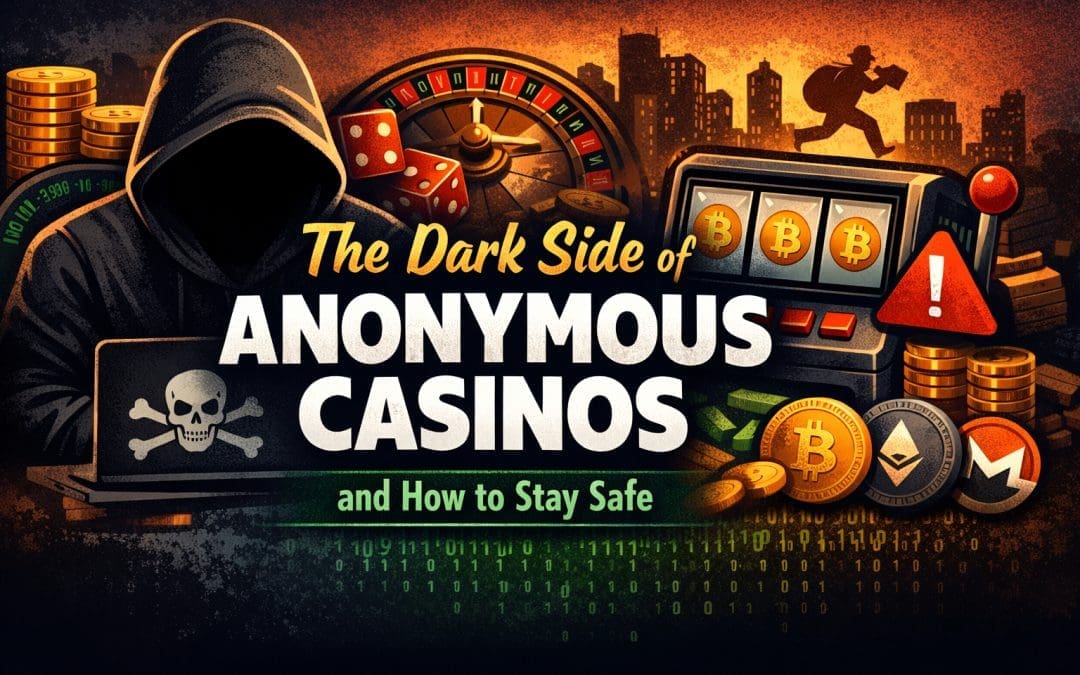
That is the dark side of anonymous casinos. Not privacy itself. Not crypto itself. Not even no KYC by itself. The real danger is the vacuum that forms when privacy, weak oversight, bad security, and easy money collide.
For some players, that vacuum turns into a frozen withdrawal. For others, it turns into drained wallets, impossible disputes, tax headaches, or months of chasing support tickets that go nowhere. And for a smaller but very real group, it turns into a habit that becomes harder to see and harder to stop precisely because it was built to leave less trace.
If you want to gamble anonymously, be honest about what you are buying and what you are giving up. You are buying speed, distance, and privacy. You may be giving up recourse, transparency, and a meaningful safety net.
That trade can make sense only when you understand it clearly, keep your exposure small, and treat every anonymous casino as untrusted until it earns otherwise through behavior, not slogans.