
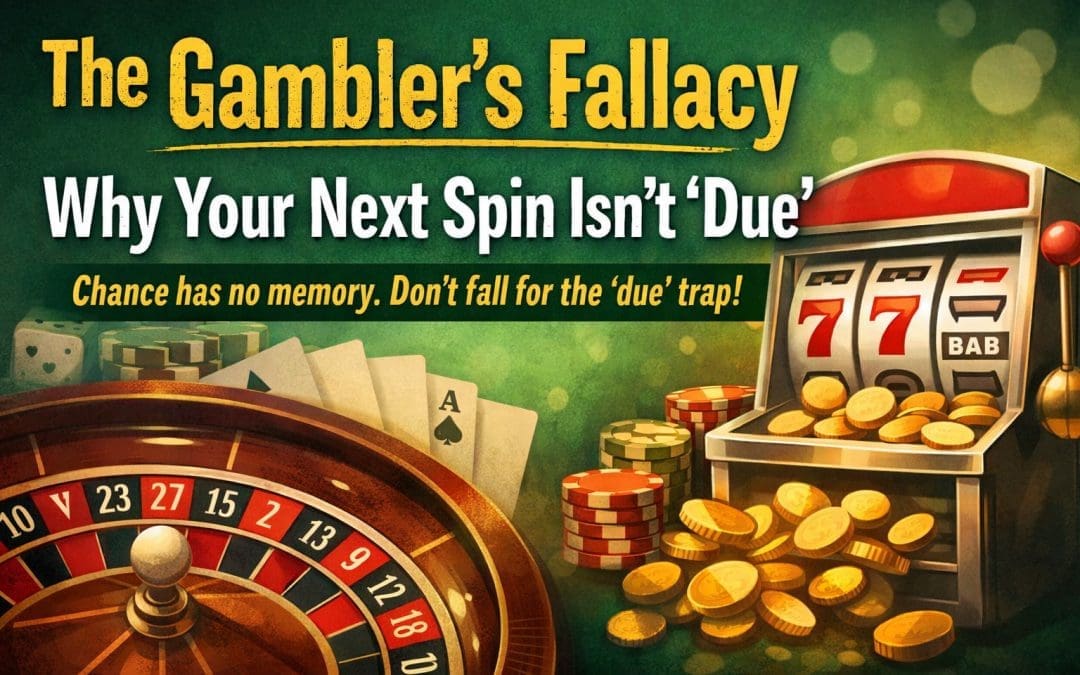
You know that moment when you are gambling. It is when you see the roulette wheel stop on red times in a row.. It is when you play a slot machine and it does not give you a bonus for a long time like twenty spins or so. Even if you are just flipping a coin it starts to feel like the coin does not want to land on heads. The roulette wheel and the slot machine and the coin they all seem to be going against you. At some point you start to think that things have to change. You think that the next time will be different. It seems like it should be that way. You feel like you deserve it to change. The spin of the roulette wheel or the next pull of the slot machine it feels like it is overdue, for a change. The roulette wheel and the slot machine they have to change.
The gamblers fallacy is what is happening here. It makes people think that something will happen because it has not happened in a while. The gamblers fallacy has been causing problems for people who gamble for a long time. It has taken away their money made them feel bad, about themselves and made them make decisions. The gamblers fallacy is a problem that affects the gamblers life in many ways.
You see this mistake over the place where people gamble like at roulette tables filled with smoke or on phone screens that have slot games on them at midnight. This mistake also happens in our lives and it looks like we are just following our instincts or trying to figure out a pattern. The thing is, people are not bad at math. The thing is, our brains are really good at finding stories when all we are really seeing is things happening by chance. We like to think that there is a reason, for everything. Sometimes things just happen and that is it.
What Is the Gambler’s Fallacy?
The gamblers fallacy is when people think that things that happened before will change what happens next. This is not true. Just because something happened a lot it does not mean the opposite will happen time. The gamblers fallacy is, about the gamblers fallacy. People think that if something has not happened in a while it is bound to happen. They think it is due to happen. The gamblers fallacy is wrong because each event is separate and the past does not affect the future.
People think that if they get five reds in a row on roulette then black is going to come up because it is due. They also think that if they lose ten times on a slot machine they have to win. Some people even think that after they have not won anything for a time the machine owes them a win. The idea of the roulette and the slot machine owing them something is really, about the framing of these games, where people believe that the roulette and the slot machine will balance out the wins and losses so they think that if they have a lot of losses the roulette and the slot machine must give them a win.
That thing just does not work.
Core definition and simple examples
Think about flipping a coin. It is a coin. You flip it. It comes up heads six times in a row. Now you flip it again for the time. The chance of getting heads is still fifty percent. It is not forty percent. It is not thirty percent. It is not than fifty percent just because heads came up before. The thing, about this coin is that it does not remember what happened before. The coin has no memory of the flips. The chance of heads is fifty percent every time you flip the coin.
People usually call this the coin flip fallacy.. The same idea applies to gambling. A roulette wheel that is fair does not change itself to make things after a few losses. A slot machine that is regulated does not keep track of your twenty tries and then give you a reward because you waited. The roulette wheel and the slot machine do the thing every time. They pick a result from the group of possibilities and it is always a new pick. The roulette wheel and the slot machine do not care about what happened. Each time you play the roulette wheel or the slot machine it is, like a game. The result of the roulette wheel and the result of the slot machine are separate. They do not affect each other.
People who gamble often have an idea about this. They think that things will even out in the term because they do in the long term. The gamblers misconception is really, about this idea that short-term balance must happen because the gambler knows that long-term balance exists.
Difference from the hot hand fallacy
The gamblers fallacy is often mixed up with something the hot hand fallacy. These two things are actually opposites. They come from the mistake people make when they think about things. The gamblers fallacy and the hot hand fallacy are, like two sides of the coin.
The gamblers fallacy is this idea that a streak has to end because it has been going on for long. People think that just because something has happened a lot it will not happen again.
The hot hand fallacy is the opposite. It says that a streak will keep going because it has already been going on for a time. You see the gamblers fallacy and the hot hand fallacy all the time when people are gambling.
One person will bet against the color red because it has been hitting a lot. They think it is time for something else to happen.
Another person will bet on the color red because they think it is, on a roll. They think that because red has been hitting a lot it will just keep on hitting.
People have these two ideas that’re not really true. They forget one thing: things that happen by chance do not think about what happened before. The roulette wheel does not get hot or cold. The slot machine is not getting ready to pay out.
Your brain has a time dealing with things that happen by chance when they do not happen in a simple way. The roulette wheel and the slot machine are examples of this. These things do not care about what happened they just do their own thing.
Classic Real-World Examples
The gamblers fallacy is something that people should know about. It is not some complicated idea that scholars talk about. The gamblers fallacy has happened times in the past. We have seen the gamblers fallacy show up in ways for everyone to see and it has cost people a lot of money. The gamblers fallacy has been a part of history. It is still something that we deal with today.
The famous Monte Carlo incident
Something crazy happened at the Monte Carlo Casino in 1913.
The Monte Carlo Casino had a game of roulette where the ball landed on twenty six times in a row.
People who were betting lost a lot of money because they kept betting on red they thought that the Monte Carlo Casino roulette game could not have black come up that times.
The roulette game, at the Monte Carlo Casino is an example of this.
That thing really did work out. The situation we were talking about it actually did happen.
This story is powerful because of how people react to it. A long streak is not that surprising if you do something times. What is really interesting is how people respond to the streak. The players in this story kept betting money as the streak went on. They did this because they thought that the streak could not keep going which is called the gamblers fallacy. Each time they spun and lost it felt like something was off. Each loss made them think that they were getting closer, to winning that a win was coming soon. The roulette players thought that the next spin would be the one to turn things around.
No correction ever came. The wheel just kept turning around doing what the wheel does which is to keep on moving in a circle.
Coin flips, roulette, and slots
Roulette is a good example of this. Each time the wheel spins it is a separate thing. You can see the ball bouncing around and the wheel turning. There is nothing that connects what happens one time to what happens the time.. Even so people who play roulette still think that what happened before will affect what happens next. They feel like there is a kind of momentum with Roulette. Roulette is a game where people think that if something happens a times, in a row it will keep happening.
Slots are like a trick. The reels go around the symbols line up. It looks like you are about to win. When you see two bonus symbols come up and the third one barely misses it feels like you are getting somewhere. It feels like the machine is getting ready to give you something.. The truth is, that time when you almost won is really no different from any other time when you did not win. The machine does not care about the bonus symbols you just saw. It is just as likely to give you a bonus the next time as it was the time before. Slots are like that they make you think you are close, to winning but it is all just a trick.
People talk about something called the “slot machine fallacy”. This is why. The way these machines are made gets people looking for patterns.. The truth is, the math behind them does not care. It is like the machine is completely indifferent, to what people think. The “slot machine due fallacy” is a thing because people keep thinking they can figure out when a machine will pay out.. The “slot machine due fallacy” is just that. A mistake people make when they think the machine will follow a pattern.
Why Your Brain Falls for It
To really get the gamblers fallacy you need to understand how people think when things are not certain. The problem is not about being smart. Some smart people throughout history have had wrong ideas, about probability. The gamblers fallacy is a mistake that even the brightest minds can make.
Cognitive biases at play
For a time psychologists have been trying to understand the mistakes people make. Daniel Kahneman and Amos Tversky are two people who have done a lot of work on this. What they found out is that people use ways to think when things are random. These simple ways are helpful in life.. They can be really bad for you if you are in a casino and you gamble. People make these mistakes because they use shortcuts. These shortcuts are useful when you are just living your life.. When you are dealing with chance like, in a casino they can be very bad. Daniel Kahneman and Amos Tversky showed that people rely on these shortcuts.
The representativeness heuristic is really powerful. People think that small groups should be similar to the thing. For example a roulette wheel is half red and half black after a lot of spins. So people expect that if they watch ten spins it should be pretty even. The representativeness heuristic is what makes people think this way. When the ten spins do not look balanced the brain gets confused. It thinks something is wrong. It needs to be fixed. The representativeness heuristic is what tells people that things should be a way like the roulette wheel being half red and half black even, with just a few spins.
The availability heuristic is another thing that plays a role. We tend to remember the dramatic moments. For example you will probably remember the time the machine paid out after a time of not paying out.. You will not remember all the other times the machine did not pay out and there were probably dozens of those times. The machine and its payouts are what stick in your memory the machine paying out after a dry spell.
The illusion of patterns in randomness
Humans are really good at finding patterns. This ability to find patterns has helped humans a lot. It is safer for humans to see a pattern in something like when bushesre moving around than to think it is just random. Humans found that seeing a pattern in things, like this helped humans survive.
Randomness is weird. It does not always work out evenly. Sometimes you get clusters of the thing happening together. You also get streaks where the same thing keeps happening over. Just because you get a run of the same outcome it does not mean that something is unfair. It just means that randomness is not always nice and neat. Randomness is what makes these long runs of the outcome happen and that is just how randomness works.
This feeling of discomfort makes people think they have control over things that’re really just luck. People think that if they can just place their bet at the time or switch to a different machine when things are going well or double their bet when they are on a winning streak they can actually beat the odds. The casino games make people feel like they can outsmart chance. This feeling is very powerful. The casino games are wrong to make people feel this way. The casino games make people think they can outsmart chance. People cannot outsmart chance, with the casino games.
The Math Behind Why It’s Wrong
The gamblers fallacy is pretty easy to understand. The gamblers fallacy does not make sense because the gamblers fallacy relies on events being connected.. The truth is, each event is separate from the other events. So the gamblers fallacy falls apart when you think about the fact that each event’s independent of the other events, like the gamblers fallacy.
Probability and independent events
So what is an independent event? It is something where what happens does not depend on what happened. For example when you play Roulette each spin is an event. The same thing is true, for Slot machines each spin is independent. When you draw cards from a deck that has been shuffled these are also events, that is until you change the deck. Roulette spins are an example of independent events. Slot spins are independent too. Card draws from a shuffled deck are events until the deck is changed.
The chance of getting red on a roulette wheel is about forty eight percent. This probability does not change, no matter what happened before. It stays the same whether red came up once or twenty times in a row.
The same thing is true for slot machines. If a bonus comes up on average once every one hundred spins, the spin that comes before the bonus, which is spin number ninety nine is not special at all. It is like any other spin, such as spin number three. The roulette wheel and the slot machine do not care about what happened the probability of red on the roulette wheel and the bonus, on the slot machine stays the same.
The idea that something is due to happen assumes that the system is actually keeping track of things.. The truth is, gambling machines do not have memories like people do. They do not remember what happened before so they are not keeping track of what’s due to happen next. Gambling machines just do their thing and that is it. The idea of something being due is really something that people think about it is not something that the gambling machines think about.
The law of numbers is a pretty simple idea. It says that when you do something times the average result will be very close to the expected result. For example if you flip a coin times the law of large numbers says that the number of times the coin lands on heads will be very close to the number of times it lands on tails.
The law of numbers is important because it helps us understand how things work when we do them many times. It is used in areas, such as insurance, gambling and science. The law of numbers is a fundamental concept in statistics and it is used to make predictions about what will happen in the future.
The law of numbers is based on the idea that the average result will get closer and closer to the expected result as the number of trials increases. This means that the times you do something the more likely it is that the average result will be close to the expected result. The law of numbers is a powerful tool for understanding how the world works. The law of numbers is very useful, for making predictions and decisions.
The law of numbers is something that people often do not understand. What it really says is that when you do something times the average result will be close, to what you would expect to happen. The law of numbers does not mean that things will balance out quickly. It means that the law of numbers will work over a long time not in the short term when you are talking about the law of large numbers.
People often get this wrong. Think it is the law of small numbers. This is a term that people use to talk about an idea. The wrong idea is that small groups of things should act like groups.. The truth is that small groups are not perfect. They are messy and all over the place. Small samples of things can be very different from one, to another. They can change a lot from one sample to another small sample of the same thing.
A roulette wheel will start to out over a really long time like millions of spins.. If you only look at twenty spins you can get all sorts of results. It does not make sense to think that things will be fair and balanced in a time. This is of like thinking the weather will be average, by lunchtime. A roulette wheel needs a lot of spins to start showing balance. You just can not expect a roulette wheel to be balanced over a period of time like twenty spins.
Avoiding the Fallacy in Gambling
 The gamblers fallacy is something we know about. That does not mean it goes away. We still get that feeling. So what do we do when the gamblers fallacy shows up? The important thing is to learn how to deal with the gamblers fallacy when it happens.
Practical tips for better decisions
Gamblers, like the professionals and the ones who can control themselves all do one thing that works really well. The gamblers separate how they feel from the chances of something happening. They figure out their bets before anything starts to happen not when it is already happening. The gamblers think of each spin of the wheel as a thing not as something that is connected to what just happened before.
So I want to share a trick that helps me think clearly. Imagine each thing that could happen as if it is the thing that exists. For example let us say you see a machine that you have never seen before. Do you think the machine is going to work like it should? Now think about this: if you just saw someone use the machine and it worked would that make you believe the machine is going to work when you use it? If your answer changes because of what you saw then you are probably falling for the fallacy of the machine. The machine is. Going to work or it is not and what just happened does not really change that. This trick helps me think about the machine and its outcomes in a way.
Another thing to keep in mind is that casinos do well when people have the wrong idea about what is going to happen. When you play for a time trying to make up for your losses you are actually giving the casino more chances to win. The thing is, the math is not mean to people who get bored easily. It is mean, to people who play for a time. The casinos make money from people who play a lot not from people who get tired and stop playing. Casinos make money because of the house edge and the more you play the more the house edge works against you. The house edge is what gives casinos the advantage and the more volume of bets you make the more the house edge hurts you.
People keep talking about this myth. It will not go away. This myth is very hard to forget. The myth is still talked about today. People are still discussing why this myth refuses to die. The myth is a deal and that is why it will not go away. This myth is very interesting to people. People want to know more, about the myth. That is why this myth refuses to die.
The gamblers fallacy is something that people have talked about a lot. They have said it is not true. Explained why.. The gamblers fallacy is still around. This is because it seems like it should be true. People want things to be fair and to make sense. They like when things are balanced and when stories have an ending.. Things that happen by chance do not give us any of these things. The gamblers fallacy is still around because it feels right even though it is not.
When people share stories, about machines that pay out big it makes the legend grow.. When someone gives up and walks away because they never get that payout their story is never told. The machines that do pay out get all the attention. That is what makes the legend of the machines even stronger. The fact that we only hear about the machines that pay out and not the ones that do not is what really keeps the myth of the machines alive.
Getting this concept does not mean that playing games of chance becomes boring. It means that playing games of chance becomes honest. When you win at games of chance the wins feel cleaner. When you lose at games of chance the losses feel less personal. You stop arguing with chance. Start managing the choices you make when you play games of chance.
Your next spin is not due. It never was. And the sooner that truth sinks in, the more control you regain over a game that was never designed to give you any.